Group your safety forms into connected, end-to-end processes that guide your crew through the job safely. Instead of managing disconnected forms, you can link one form to the next.
Every team has different safety challenges. Explore solutions built for the way you work, from forms and site safety to incidents, training and equipment.
At Site App Pro, we believe in the power of people. That’s why our partners are at the heart of what we do, helping businesses streamline safety processes while growing their own success.
A notifiable event is a death, a notifiable injury or illness, or a notifiable incident that arises from work. Under the Health and Safety at Work Act 2015, the PCBU must notify WorkSafe as soon as possible, preserve the site and keep a record for at least five years.
A notifiable event is one of three things that arise from work: the death of a person, a notifiable injury or illness, or a notifiable incident. Section 25 of the Health and Safety at Work Act 2015 (HSWA) sets this out. Notifying WorkSafe is one step in incident and near miss management.
Who it applies to: Every person conducting a business or undertaking (PCBU), from a two-person electrical company to a manufacturer with several plants.
Who notifies: The PCBU. Only one notification is needed per event; where several PCBUs share a site, they can agree who notifies, but all remain responsible.
Which regulator: Usually WorkSafe. Maritime NZ covers ships and major ports, and the Civil Aviation Authority covers aircraft.
A notifiable injury or illness is one that needs immediate treatment (other than first aid) for a serious injury, or admission to hospital as an inpatient for immediate treatment. WorkSafe's guidance, updated 30 October 2026, gives examples for each category. A visit to the emergency department that ends without admission is not, on its own, enough.
Serious injuries needing immediate treatment: Amputation, a serious head injury (such as a fractured skull or loss of consciousness), a serious eye injury, a serious burn, degloving or scalping, a spinal injury, loss of a bodily function or serious lacerations.
Hospital admission: Admission as an inpatient for immediate treatment.
Substance exposure: Medical treatment within 48 hours of exposure to a substance.
Serious infection: An infection where work is a significant contributing factor, such as leptospirosis on a farm or meat works, or Legionnaires' disease.
WorkSafe notes that back strain and bruising are not spinal injuries, and that superficial cuts are not serious lacerations. Sprains, strains and fractures that don't need admission are also excluded, except fractures of the skull or spine. If a worker is sent to hospital, find out whether they were admitted before deciding.
What counts as a notifiable incident?
A notifiable incident is an unplanned or uncontrolled incident that exposes a worker or anyone else to a serious risk from an immediate or imminent exposure, even if nobody is hurt. Section 24 of the HSWA lists the types. This category is often missed, because the near miss can feel like a lucky escape rather than a reportable event.
Substances and energy: A spill or leak of a substance, an explosion or fire, an escape of gas, steam or a pressurised substance, or an electric shock.
Falling objects: The fall or release from height of any plant, substance or thing, such as a load dropped from a crane.
Plant and structures: The collapse, overturning or failure of plant that must be authorised, or the collapse of a structure.
Excavations and tunnels: The collapse or failure of an excavation or its shoring, or an inrush of water, mud or gas underground.
Vessels: A collision between two vessels, a capsize or water inrush.
WorkSafe excludes shocks from static, extra-low voltage and defibrillators, and planned, controlled releases.
How and when do you notify WorkSafe?
You notify WorkSafe as soon as possible after you become aware of a notifiable event, by the fastest means available. Section 56 of the HSWA allows phone or written notice, including online. If someone has died, phone WorkSafe immediately on 0800 030 040. For other events, use the online Notify WorkSafe form.
Look after people first: Call 111 in an emergency and give first aid.
Make the area safe: Stop the work and keep others away.
Preserve the site: Under section 55, take all reasonable steps so the site is not disturbed until an inspector says so. Helping an injured person, removing a deceased person and making the site safe are allowed.
Notify: Phone or use the online form. If you notify by phone, WorkSafe can ask for a written notice within 48 hours.
Record it: Keep a record of the event and your notification.
If you're not sure it's notifiable
WorkSafe relies on the PCBU to decide, and its online Notify WorkSafe tool asks questions to help. If in doubt, check before anything at the scene is moved. Failing to notify carries fines of up to $10,000 for an individual and $50,000 for others.
What records do you need to keep?
You must keep a record of each notifiable event for at least five years from the date you notified WorkSafe, under section 57 of the HSWA. A clear incident report is the core of that record. Our guide on how to write an incident report gives a template.
The event: Date, time, place, people involved and what happened.
The notification: When and how you notified WorkSafe, and the WorkSafe reference.
Evidence: Photos, witness statements and relevant pre-starts or permits.
What changed: Investigation findings and corrective actions with owners.
The HSWA doesn't explicitly require an investigation, but WorkSafe recommends one as good practice.
How Site App Pro helps with notifiable events
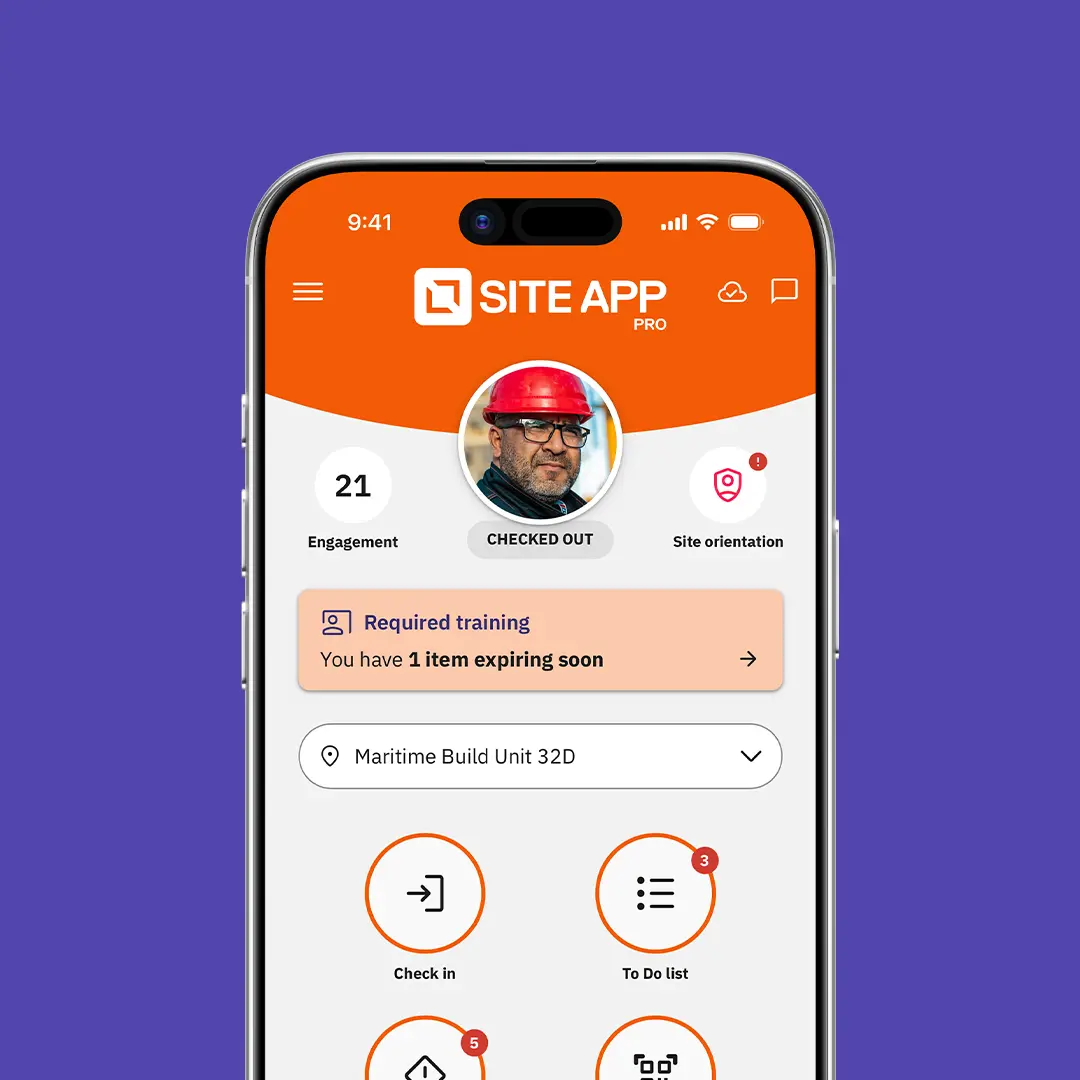
Site App Pro gives your team a quick way to record what happened while the details are fresh, wherever they are.
Incident reporting on the phone: Capture the event, photos and witness details on a digital form, even without coverage, syncing when back in range.
Investigation workflows: Send an investigation form to the right people when an incident is reported, and assign corrective actions with due dates.
One searchable record: Keep incident reports and notification details in one place for the five-year record and for audits.
After a serious event, an experienced consultant can help you work out what happened, review your controls and agree corrective actions. For legal questions, talk to a lawyer. Find a health and safety consultant near you.
Try Site App Pro for free
Start a 14-day free trial with no credit card required. Our team sets you up and uploads your existing incident forms for free. Pricing is flat-rate and user-based, and our NZ-based support team is here when you need help. Start your free trial.
A notifiable event is a death, a notifiable injury or illness, or a notifiable incident that arises from work. Under the Health and Safety at Work Act 2015, the PCBU must notify WorkSafe as soon as possible, preserve the site and keep a record for at least five years.
Ryan Hartley
CEO
Disclaimer: Site App Pro does not provide health and safety or compliance advice. This guide has been provided for information purposes only. You should consult your own professional health and safety advisors for advice directly relating to your company or before taking action in relation to any of the content provided.
You have to notify WorkSafe about a near miss only if it is a notifiable incident, such as a structure collapse or a load falling from height that exposed someone to serious risk. Most near misses are not notifiable. Recording every near miss internally still helps you fix hazards before someone is hurt.
An injury that only needs first aid is not notifiable. The HSWA definition of a notifiable injury excludes first aid treatment. Record it in your own incident or first aid register, because a pattern of minor injuries can point to a hazard that needs better controls.
A heart attack at work is not a notifiable event unless work caused or contributed to it. WorkSafe's examples of events that are not work-related include a worker fainting from a non-work cause and a medical episode unrelated to the job. If you are unsure, use WorkSafe's online tool to check.
When several companies share a site, any PCBU involved can notify, and only one notification is needed. WorkSafe suggests agreeing in advance who will do it, often the main contractor. Every PCBU involved stays responsible for making sure the notification happens.
Health and safety management software for small to enterprise New Zealand companies.