Health and Safety at Work Act NZ: A Guide for Businesses

The Health and Safety at Work Act 2015 (HSWA) is New Zealand’s core workplace safety legislation. It sets out key legal responsibilities to ensure all workers and visitors return home safely. New Zealand businesses must proactively identify hazards, manage critical risks, and involve employees in health and safety decisions.

What is the Health and Safety at Work Act (HSWA) in New Zealand?

The Health and Safety at Work Act 2015 (HSWA) is New Zealand’s main legislation governing workplace safety, designed to ensure that every worker returns home safely at the end of the day. It shifts the legal burden from reacting to accidents to proactively managing critical risk across all business activities.

As part of the Government's ongoing legislative updates, stay informed on how the latest Health and Safety at Work Amendment Act reforms impact your business duties, small PCBU thresholds, and compliance expectations.

Health and Safety at Work ActHSWA 2015
Primary duty of care
  • PCBU responsibility
  • Worker engagement
Risk and incident management
  • Hazard controls
  • WorkSafe reporting

The HSWA sets high standards for health and safety across high-risk sectors such as construction, agriculture, civil works, forestry, and manufacturing. Administered and enforced by WorkSafe New Zealand, the framework requires businesses to focus on systematic risk management rather than administrative paperwork.

Key pillars of HSWA include:

  • Shift to risk management: Moving away from simple checklist or tick box compliance to identifying, assessing, and eliminating or minimising critical risk.
  • Shared responsibility: Recognising that safety is a shared obligation among business owners, directors, main contractors, sub-contractors, and staff.
  • Focus on health and safety: Protecting employees against both physical injury and occupational health issues, such as dust exposure, mental strain, and noise-induced hearing loss.
  • Worker engagement: Requiring genuine consultation where workers actively participate in identifying hazards and shaping safety processes.

What is a PCBU and what is the primary duty of care?

A Person Conducting a Business or Undertaking (PCBU) is a foundational term under HSWA that refers to companies, sole traders, partners, and self-employed individuals in control of a work operation. A PCBU holds the primary duty of care to ensure the health and safety of its workers and anyone affected by its work.

‍

Understanding the primary duty of care

The primary duty of care requires a PCBU to ensure, so far as is reasonably practicable, the health and safety of:

  1. Direct workers: Employees, temporary staff, and apprentices carrying out work for the business.
  2. Influenced workers: Sub-contractors and site personnel whose activities are directed by the business.
  3. Other persons: Clients, site visitors, and members of the public who could be exposed to health and safety risks arising from the work.

‍

What does "reasonably practicable" mean?

Under HSWA, "reasonably practicable" means weighing what is reasonably possible in the circumstances to manage risk. PCBUs must evaluate five core factors:

1 Likelihood of risk
2 Severity of harm
3 Knowledge of hazard
4 Suitable controls
5 Proportional cost
  1. Likelihood: How probable is it that a hazard or risk will occur?
  2. Severity: How severe is the potential injury or illness that could result?
  3. Knowledge: What does the business know (or what ought it reasonably to know) about the hazard and available control measures?
  4. Availability: Are effective control measures available, and are they suitable for the specific task?
  5. Cost: As a final consideration, is the cost of eliminating or minimising the risk grossly disproportionate to the risk itself?

What do businesses need to follow to comply with HSWA?

To comply with the Health and Safety at Work Act, businesses must actively implement a structured health and safety management process. Compliance involves managing critical risks, engaging employees, maintaining clear digital paper trails, and ensuring safe working environments.

1 Identify hazards
2 Implement controls
3 Train staff
4 Digital records and forms
5 Review systems
↻ Reviewing your systems feeds back into identifying hazards

5 steps to comply with HSWA requirements

  1. Identify and control critical risks: Carry out detailed risk assessments before starting work. Prioritise critical risks in the workplace - those capable of causing serious harm or fatalities - and apply the hierarchy of controls to eliminate hazards where possible or minimise them using engineering controls and personal protective equipment (PPE).
  2. Engage with workers: Establish formal worker participation systems, such as health and safety representatives (HSRs) or regular toolbox talks or daily meetings, allowing staff to report issues and give feedback on safety procedures.
  3. Provide training and supervision: Ensure workers receive proper onboarding or inductions, clear task instructions, and ongoing supervision necessary to perform their roles safely.
  4. Manage overlapping PCBUs: When operating on multi-contractor sites (e.g., civil construction or building projects), consult, cooperate, and coordinate activities with other PCBUs to manage shared site risks effectively.
  5. Utilise standardised health and safety forms: Replace paper systems with clear, accessible health and safety forms. Moving to a dedicated safety mobile app allows teams to complete site inductions, risk assessments, and daily pre-start checks directly from where they are working.
Compliance AreaPaper-Based SetupDigital Safety System
InductionsPaper forms stored in a site office binderInstant mobile inductions signed on-site
Hazard ReportingManual submission, delayed follow-upReal-time photo uploads and immediate alerts
Corrective ActionsPen-and-paper tasking; easily misplacedAutomated task assignment with digital tracking
Audit ReadinessSearching through physical foldersOne-click searchable reports for WorkSafe audits

How to manage health and safety reporting, near misses, and corrective actions

Effective health and safety reporting requires recording every incident, near miss, and hazardous condition as soon as it occurs. Capturing near misses provides valuable data to correct issues before they cause actual harm.

Incident or near miss occurs
Immediate real-time reportingMobile photo and incident log
Is it a notifiable event?

Yes: notifiable

Notify WorkSafe immediately
Preserve the scene until cleared

No: non-notifiable

Record and continue to investigation
Investigate root cause
Assign corrective actionsDigital tracking and closure

1. Mandatory reporting and WorkSafe notification

Under HSWA, PCBUs must notify WorkSafe New Zealand immediately when a notifiable event occurs.

A notifiable event includes:

  • The death of a person.
  • A serious injury or illness requiring immediate medical treatment.
  • A dangerous incident that exposes a worker or site visitor to a serious risk to their health and safety.

    If a notifiable event occurs, the PCBU must ensure the site is preserved until an inspector gives permission, notify WorkSafe by the fastest available route, and keep formal records of the event for at least 5 years.

2. Logging near misses and incidents

A robust workplace culture treats near misses as early warning signs. Using digital health and safety management software allows workers on site to capture photos, record details, and log hazards instantly without returning to an office.
‍

3. Assigning and closing corrective actions

Reporting an incident is only effective if it leads to preventive action. Assign clear corrective actions to specific team members with firm completion dates. Tracking these actions digitally provides full accountability, ensuring that controls are put in place and evaluated for long-term effectiveness.

Three key takeaways to HSWA

  1. Safety is proactive, not reactive: As a PCBU, your primary duty of care requires you to systematically identify, assess, and control hazards before they lead to incidents.
  2. Prioritise critical risks: Compliance is not about endless paperwork for minor issues - it is about identifying high-consequence hazards that cause severe harm and applying robust controls.
  3. Engagement and proof matter: Managing safety requires clear, open communication with site workers alongside a verifiable digital paper trail of inductions, risk assessments, and incident reports.

Find a health and safety consultant

If you need tailored guidance on developing complex safety systems, conducting specialised site audits, or interpreting compliance requirements for your specific trade, working with a qualified health and safety consultant is a great step. Qualified advisors can review your operations and help build risk frameworks customised to your business.

Try Site App Pro for free

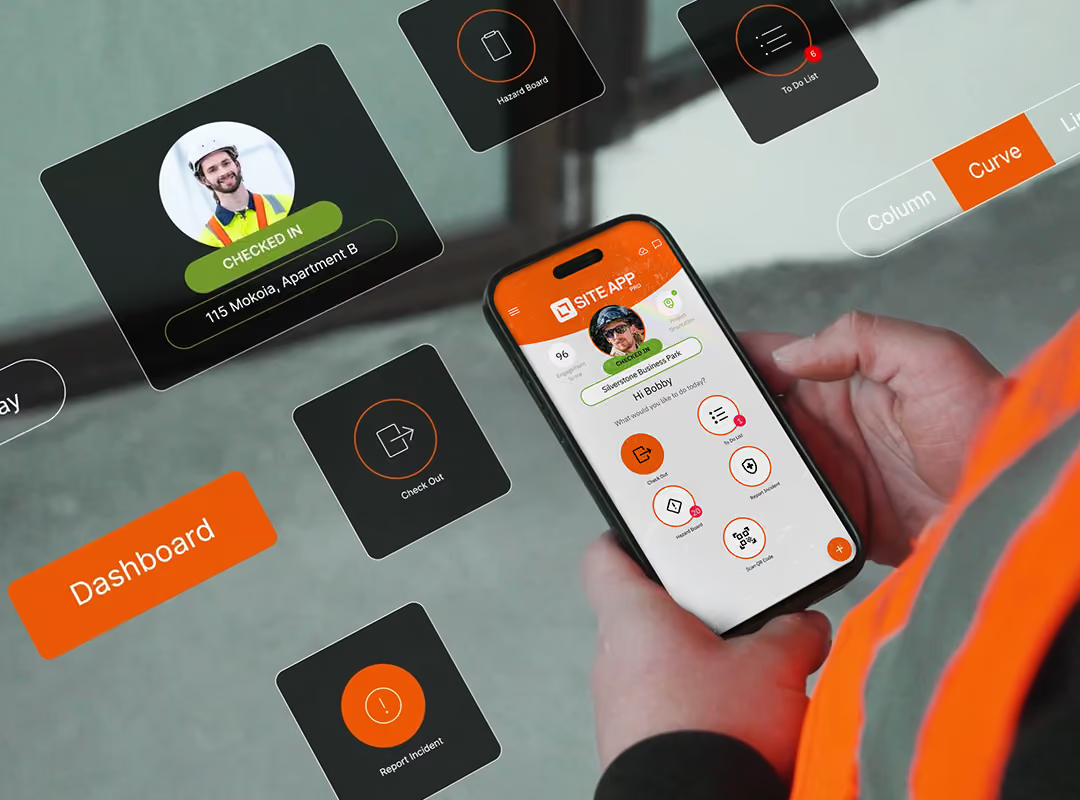
Streamlining your HSWA compliance shouldn't mean drowning in paperwork. Site App Pro gives construction, trade, and field teams an easy-to-use mobile platform to record near misses, complete daily inductions, manage hazard registers, and track corrective actions on-site.

  • No setup fees: We will transfer and upload your existing paper forms free of charge.
  • Flexible contracts: Month-to-month flexibility with no long-term lock-ins.
  • All-inclusive access: Get every feature included without hidden add-on costs.

Start your free trial with Site App Pro today and ensure your team comes home safely every day.

Disclaimer: Site App Pro does not provide health and safety or compliance advice. This guide has been provided for information purposes only. You should consult your own professional health and safety advisors for advice directly relating to your company or before taking action in relation to any of the content provided.

Citations and references

Site supervisor in a hard hat using a tablet above a busy construction site

Health and safety management software for small to enterprise New Zealand companies.

  • One online location
  • Customisable forms and dashboards
Book a demo