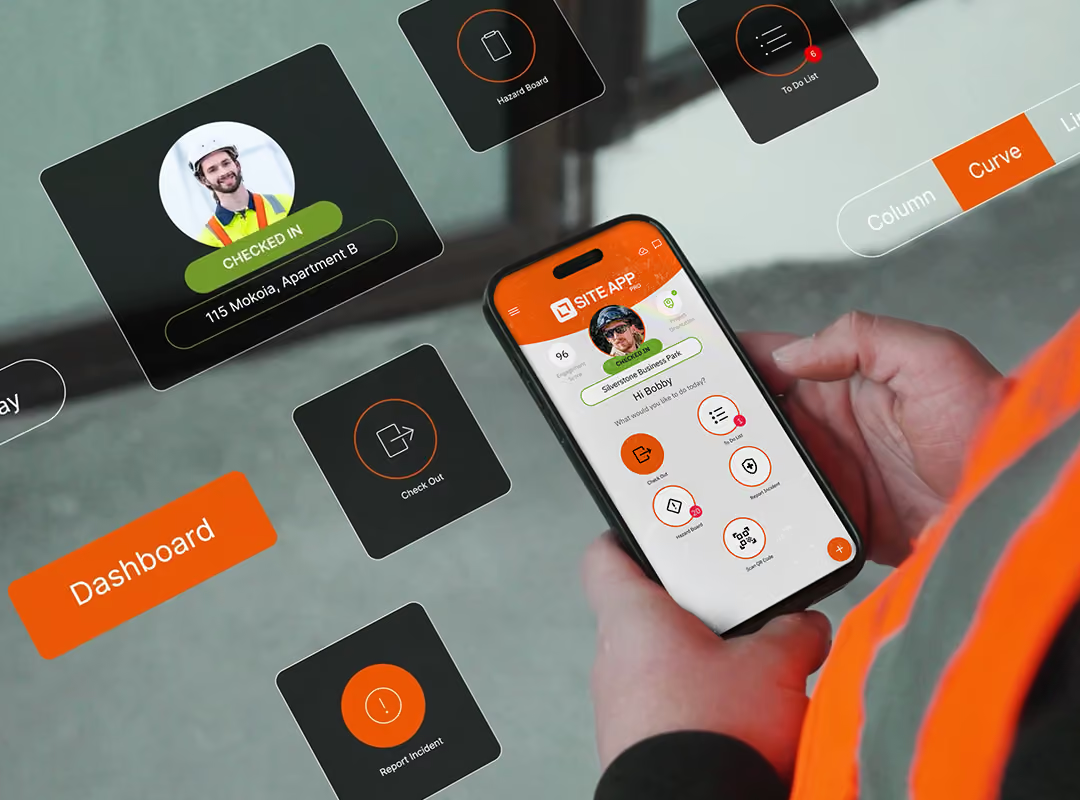
Group your safety forms into connected, end-to-end processes that guide your crew through the job safely. Instead of managing disconnected forms, you can link one form to the next.

At Site App Pro, we believe in the power of people. That’s why our partners are at the heart of what we do, helping businesses streamline safety processes while growing their own success.

We have an amazing support team dedicated to helping you and your business succeed with Site App Pro and answer any questions you may have.
Workplace Safety Glossary
Plain-English definitions of OSHA, JSA, PPE, near miss and other workplace safety terms used by US construction and field teams.
Avetta
A supply chain risk management platform that helps businesses vet, qualify, and monitor contractors and vendors. It ensures third-party companies meet specified safety, compliance, insurance, and sustainability standards before performing work on-site.
Close call
A close call, also known as a near miss, is an unplanned, unexpected event that had the potential to cause injury, illness, or property damage, but resulted in none. It serves as a critical warning sign to identify and mitigate hazards before an actual incident occurs.
Corrective and preventive action (CAPA)
Corrective and preventive action is a systemic process used to address workplace safety issues. Corrective actions eliminate the root cause of an identified incident or non-conformity, while preventive actions proactively address potential hazards to prevent future occurrences.
Hazard log
A hazard log is a centralized document or digital record used to identify, track, and manage potential safety risks on a job site. It details discovered hazards, assigned risk levels, control measures implemented, and current resolution status.
ISNetworld
A global online contractor management database that collects, evaluates, and verifies contractors' safety records, insurance, procurement, and regulatory compliance data, enabling hiring organizations to select qualified and compliant partners.
ISO 45001
ISO 45001 is the international standard for occupational health and safety management systems. It provides a structured framework for organizations to proactively improve employee safety, reduce workplace risks, and create healthier, safer working conditions.
JHA (Job Hazard Analysis)
A JHA is a safety technique that focuses on job tasks as a way to identify hazards before they occur. A job hazard analysis examines the relationship between the worker, the task, the tools, and the work environment to implement effective controls.
JSA (Job Safety Analysis)
A JSA is a procedure that breaks down specific job tasks into step-by-step components to identify potential safety hazards at each phase. A job safety analysis establishes safe operating methods and required risk controls for workers to follow.
Near miss
A near miss or close call is an incident where no employee was injured and no property was damaged, but where damage or injury easily could have occurred under slightly different circumstances. Reporting near misses helps prevent future serious accidents.
OSHA (Occupational Safety and Health Administration)
The Occupational Safety and Health Administration (OSHA) is a federal agency under the U.S. Department of Labor responsible for setting and enforcing protective workplace safety and health standards in the US, as well as providing safety training, outreach, education, and compliance assistance.
OSH Act (Occupational Safety and Health Act of 1970)
The OSH Act is a landmark U.S. federal legislation that created OSHA and established the General Duty Clause, requiring employers to provide workers with an environment free from recognized hazards that cause or are likely to cause death or serious harm in the US.
OSHA recordable incident
An OSHA recordable incident is a workplace injury or illness that must be formally logged under OSHA regulations. This includes work-related fatalities, cases involving loss of consciousness, days away from work, restricted work activity, job transfer, or medical treatment beyond first aid.
PPE (Personal Protective Equipment)
PPE is specialized gear or clothing worn by workers to minimize exposure to hazards that cause serious workplace injuries and illnesses. Common examples include hard hats, safety glasses, high-visibility vests, steel-toe boots, respirators, and hearing protection.
Safety committee
A safety committee is a collaborative group composed of employer and employee representatives who meet regularly to review safety policies, analyze incident reports, conduct workplace audits, and recommend improvements to maintain a safe work environment.
SDS / MSDS (Safety Data Sheet / Material Safety Data Sheet)
A SDS or MSDS is a detailed document providing essential safety information about hazardous chemicals. Standardized under the Globally Harmonized System (GHS), it outlines physical properties, health hazards, protective measures, handling, storage, and emergency first-aid procedures.
Site orientation
A site orientation is an initial safety onboarding session provided to workers, contractors, and visitors upon arriving at a job site. It covers site-specific hazards, emergency procedures, required PPE, safety rules, and key personnel contact information.
Toolbox talk / Tailgate meeting
A toolbox talk or tailgate meeting is a short, informal safety briefing held directly at the job site before starting a work shift or specific task. It addresses single safety topics, daily task-specific hazards, safe work procedures, or recent incidents.
Workers compensation
A workers compensation is a mandatory form of insurance providing financial compensation and medical benefits to employees who suffer work-related injuries or illnesses. In exchange, workers generally forfeit the right to sue their employer for negligence.